Firmware architecture
Flipper One uses a dual-processor architecture with a high-performance CPU (Rockchip RK3576) and a low-power MCU (Raspberry Pi RP2350). While the CPU runs Linux and manages all high-level peripherals (USB, HDMI, M.2, Wi-Fi, Ethernet, and audio), the MCU is responsible for the following tasks:
- Rendering images on the LCD display and controlling backlight brightness.
- Processing events from the buttons and touchpad, and controlling haptic feedback.
- Handling 3.5 mm audio jack connect/disconnect and headset button press events.
- Managing the battery and power subsystems.
- Managing system power states and implementing Power Bank mode.
- Managing the main CPU power-on sequence and boot process.
- Handling communication over the CC pins of the USB-C ports.
- Exposing two PIO (Programmable I/O) pins to the GPIO expansion connector.
- Controlling all device LEDs.
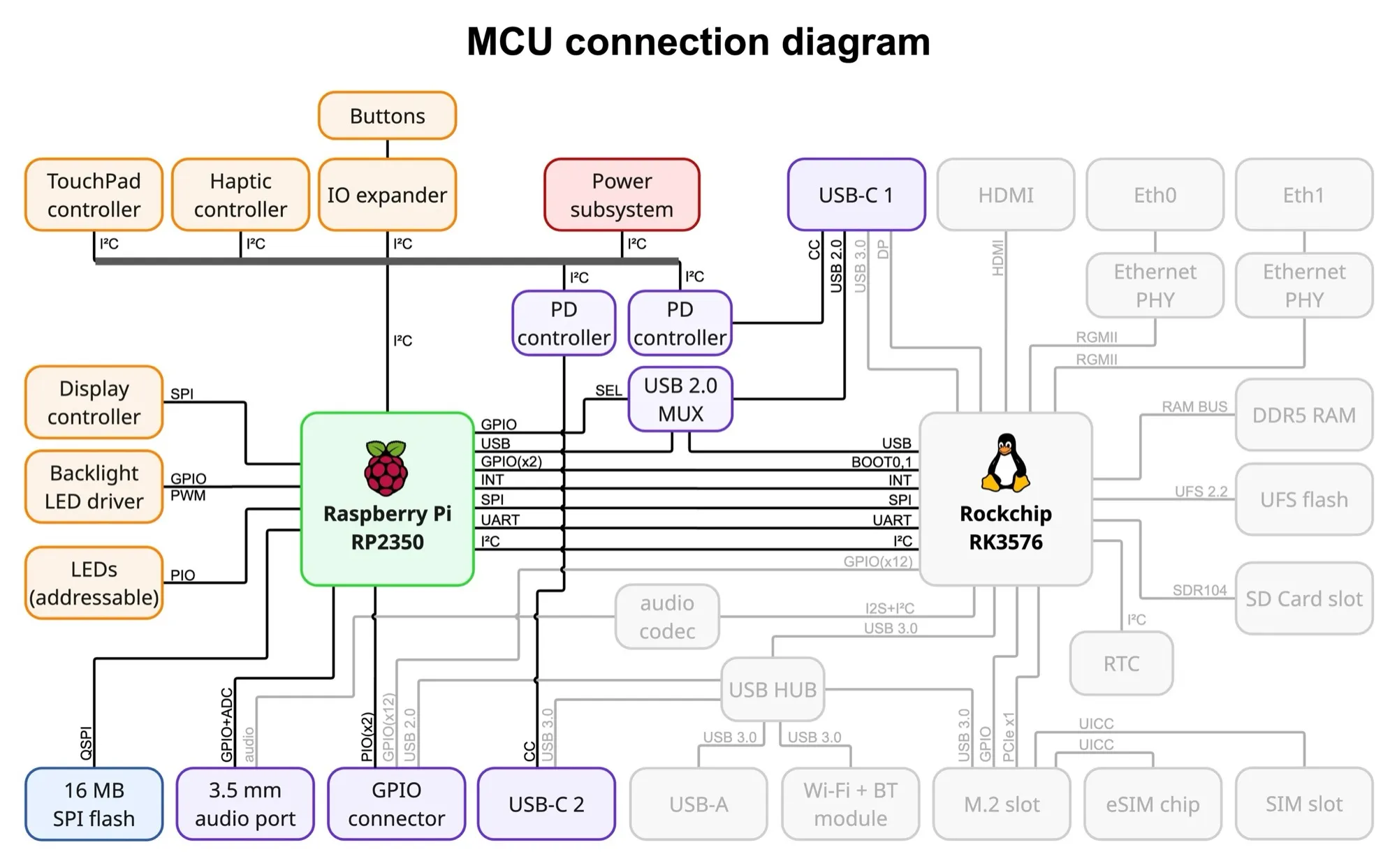
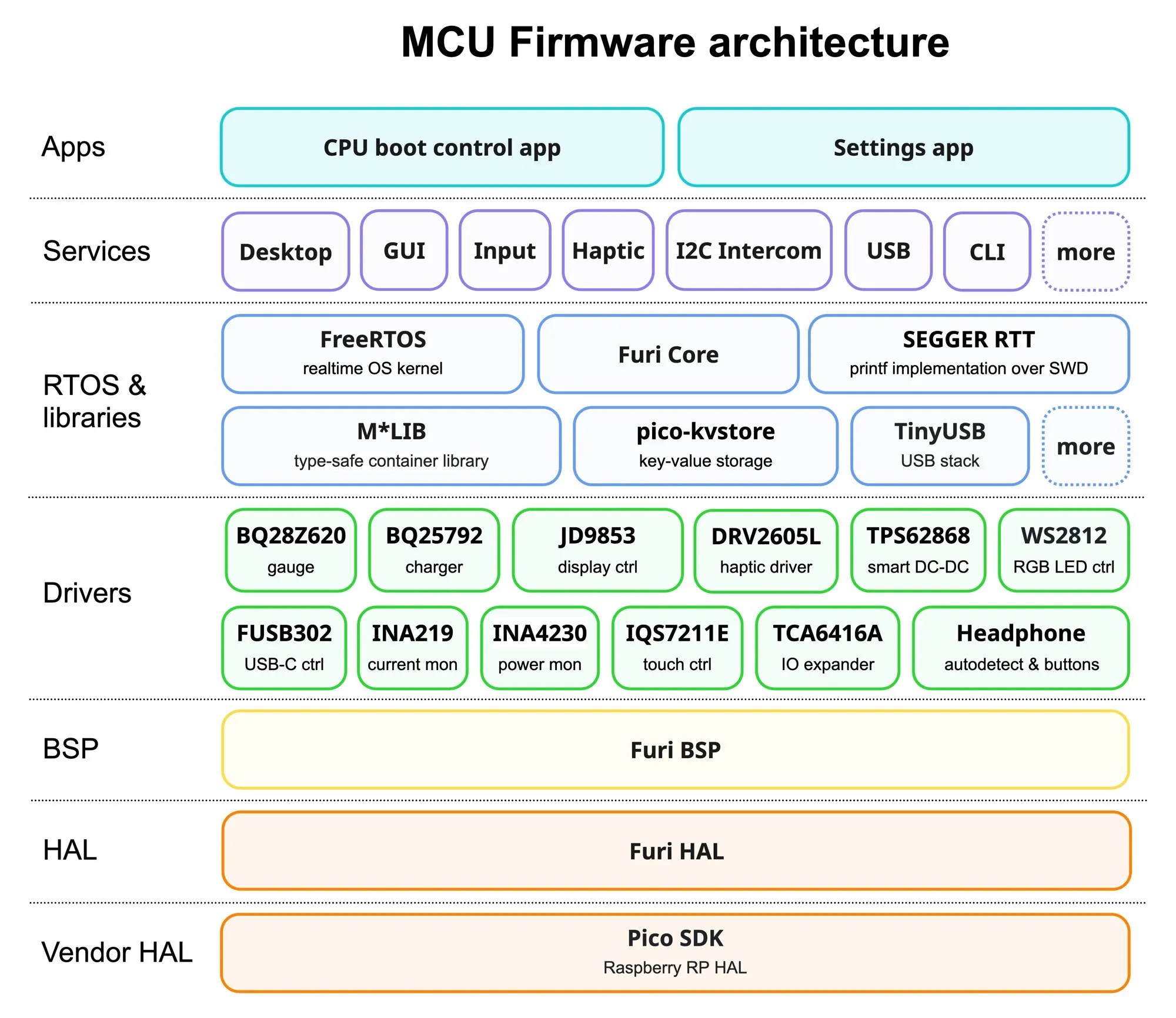
Firmware architecture
The MCU firmware is built on the FreeRTOS kernel and a set of libraries and drivers organized in a layered architecture.
Have a question?
Our support team and an awesome community will get you an answer in a flash. Please leave your questions in English.
To ask a question or participate in discussions, you'll need to authenticate first.